Choosing the right B2B contact search tool can make all the difference in driving your team’s success—but with so many options and pricing models out there, it’s easy to feel overwhelmed. As sales, business development, and marketing professionals know, every dollar counts and every lead matters. With prospecting technology evolving rapidly and contact data constantly changing, it’s more important than ever to invest wisely. In this article,
This guide breaks down how contact search pricing works, compares the major providers side by side, and helps you find the plan that fits your team’s size and workflow—especially important as 60% of sales leaders are planning to invest in prospecting technology. We’ll cut through the noise and give you the insights needed to find a solution that delivers real value and drives impact.
What is contact search pricing?
Contact search pricing refers to what B2B tools charge to help you find professional email addresses, phone numbers, and company data. Specifically, these are lead intelligence platforms that sales, revenue operations, and marketing teams use to find and connect with decision-makers.
Costs typically range from a few cents per contact on high-volume plans to several dollars per lookup on entry-level options. Pricing can vary based on data quality, verification rates, and data richness, which is critical as contact data decays at a rate of 25% annually. Some important considerations when evaluating tools include:
- Contact search tools: Software that locates verified business contact information, addressing the fact that 45% of selling professionals say incomplete data is their biggest obstacle
- Pricing models: Credits, subscriptions, or pay-as-you-go billing
- Common use cases: Sales prospecting, recruiting, and account-based marketing
Comparing contact search pricing across top providers
Prices can differ significantly between platforms. Some charge per lookup, others offer unlimited access, and a few require custom quotes. Below is an overview of how the major players compare.
| Provider | Free Plan | Entry-Level Pricing | Best For |
| RocketReach | Yes | Starting at $29/month | Teams wanting verified data with high deliverability |
| ZoomInfo | Limited | Custom enterprise pricing | Large organizations |
| Apollo.io | Yes | Freemium with paid tiers | Startups and early-stage teams |
| Lusha | Yes | Credit-based system | Quick individual lookups |
| Cognism | No | Custom pricing | European market coverage |
| Hunter.io | Yes | Email-focused tiers | Email-only discovery |
RocketReach pricing plans
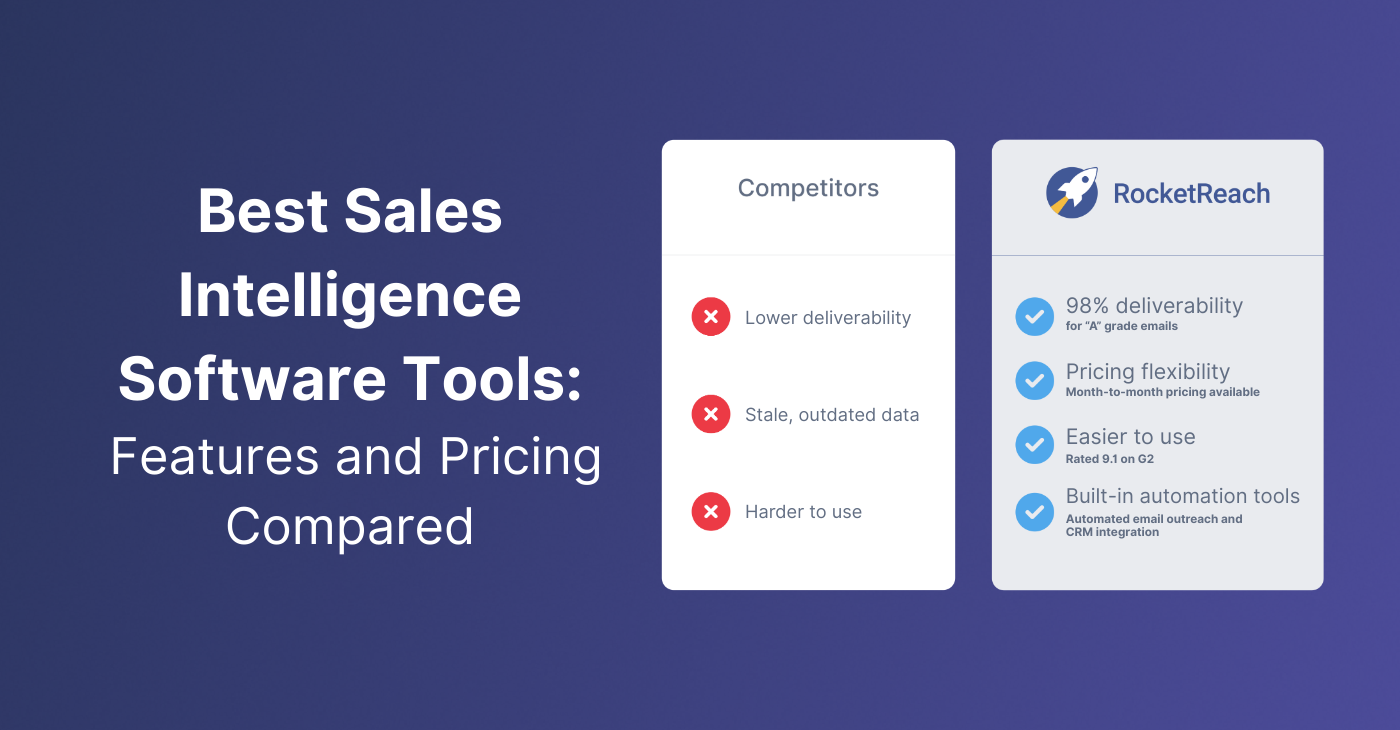
RocketReach offers convenient tiered pricing for individuals and teams, starting at $33 per month. Where they excel is by offering verified contacts with a 90–98% email deliverability rate, along with integrated outreach tools.
You’re not just buying a database. With features like Sequences and Autopilot, you can go from finding a contact to sending personalized email outreach all within one platform.
ZoomInfo pricing plans
ZoomInfo markets itself as an enterprise-level platform. Pricing information isn’t available publicly—you’ll need to contact their sales team for a quote. Generally, their rates can be considerably higher compared to alternative solutions.
For large organizations with complex data requirements and substantial budgets, ZoomInfo offers deep firmographic information. Smaller teams seeking quality contact data without the tech bloat, there are alternative, cost-effective options.
Apollo.io pricing plans
Apollo uses a freemium model that works well for startups testing the waters. The free tier gives you limited access, while paid plans unlock additional credits and capabilities.
One thing to keep in mind: features like intent data and certain integrations often sit behind higher priced tiers. The entry price might not reflect your actual cost should you need those extras.
Lusha pricing plans
Lusha runs on credits—each lookup uses credits from your monthly allocation. Free plans include a small number, with paid options providing more.
The platform easily handles quick, individual lookups, however, teams doing high-volume prospecting sometimes burn through their credits faster than expected.
Cognism pricing plans
Cognism focuses on European data quality and uses a custom enterprise pricing model. Since there’s no self-serve option, you’ll need to work directly with their sales team for pricing and activation.
If your target market is primarily EMEA, Cognism’s regional expertise can be valuable. For global coverage, evaluating providers with broader databases may make better sense.
Hunter.io pricing plans
Hunter specializes in email discovery with straightforward pricing. A free tier allows limited searches, while paid plans scale based on need and volume.
One downside is that Hunter is limited to email addresses. If you need phone numbers or more detailed company information, you’ll probably need to use an additional tool.
How contact search pricing models work
Before diving into specific plans, let’s review the three main pricing models. Each model fits different workflows and budgets.
Credit-based pricing
Credits work like tokens—you exchange them for individual contact lookups. Depending on the provider, unused credits might reset monthly or roll over to the next period.
This model fits well when your lookup volume changes month to month. Just watch your balance so you don’t run out during an important campaign.
Subscription pricing
Flat monthly or annual fees give you unlimited or tiered access. You know exactly what you’ll pay each billing cycle, which makes budgeting straightforward.
Teams with predictable, high-volume prospecting often prefer subscriptions. The per-contact cost drops significantly when you’re doing hundreds or thousands of lookups each month.
Usage-based pricing
Pay-as-you-go pricing scales with your actual lookups or API calls. You’re charged based on consumption rather than a fixed allocation.
Developers building custom integrations and teams with variable usage patterns tend to gravitate toward this model. It offers flexibility, though it requires monitoring to avoid surprise bills.
What affects contact search pricing
The sticker price only tells part of the story. Several factors can influence what you’ll actually pay and the value you’ll receive.
Number of users and seats
Most providers charge per seat, so team size directly impacts monthly costs. A five-person sales team pays more than a solo founder, even for identical data access.
Some platforms offer team plans with volume discounts. If you’re scaling, asking about pricing breaks at different seat counts can save money.
Contact credits and lookups
Your lookup volume determines which tier makes sense. Doing 100 searches monthly? An entry-level plan probably covers you. Doing 5,000? You’ll want a higher tier or unlimited access.
Estimating your realistic monthly usage before committing helps avoid two problems: overpaying for capacity you won’t use, or hitting limits that interrupt your workflow.
Data quality and verification rates
Providers with higher email deliverability and verified data often come at a higher price point. That premium usually pays off, as bad data not only wastes time you could be using to connect with prospects, it can damage your email sender reputation.
RocketReach stands out with a 90–98% deliverability rate on verified emails. Fewer bounces mean more conversations, which often makes the investment worthwhile.
Features and integrations included
Basic plans typically cover search and export. Advanced capabilities often require upgrades:
- CRM integrations: Salesforce and HubSpot sync
- API access: Custom workflow automation
- Intent data: Signals showing which accounts are actively researching solutions
- Automated outreach: Built-in email sequences and follow-ups
Mapping your feature requirements before comparing prices helps you find the best value, not just the lowest cost.
Best contact search pricing by team size
Your organization’s size shapes which pricing tier delivers the best return. Here’s how to think about it.
For individual users and freelancers
Free tiers or low-cost plans with limited monthly credits typically work best for targeted outreach, not mass prospecting.
These options are a great opportunity to test data quality across providers. This will help you determine which platform delivers the most accurate contacts for your specific industry.
For small and growing teams
Mid-tier plans with multiple seats and moderate credit allocations hit the sweet spot. Collaboration features like shared lists and team dashboards start mattering more here.
Integration features are convenient for organizations with a more mature tech stack. A platform that connects with your CRM can eliminate hours of manual data entry every week.
For mid-market companies
Team or professional plans with CRM integrations and higher volumes are crucial for scaling outreach efforts with accurate data. You’re likely running coordinated campaigns across multiple reps.
RocketReach’s team plans fit this segment well, combining verified data with built-in outreach tools like Messages and Autopilot for automated prospecting workflows.
For enterprise organizations
Custom quotes are standard at enterprise scale. Evaluating API access, dedicated support, security compliance, and data governance capabilities matters most here.
Negotiating based on your total expected usage often unlocks flexibility that isn’t advertised on public pricing pages.
How to choose the right contact search plan
Selecting a plan involves more than comparing monthly costs. Here’s a practical framework:
- Assess your lookup volume: Estimate monthly contact searches based on your prospecting cadence
- Identify required features: Determine whether you want CRM sync, browser extension, API access, or automated outreach
- Evaluate data coverage: Confirm the provider covers your target industries and geographic regions
- Test before committing: Use free trials to validate data quality for your specific use case
- Calculate total cost of ownership: Factor in per-seat costs, overage fees, and potential annual discounts
RocketReach offers a free plan that lets you test data quality before upgrading, which reduces the risk of committing to a platform that doesn’t fit your workflow.
Get the best value with RocketReach
Selecting the ideal B2B contact search tool is a key strategic choice that can significantly influence your team’s productivity and outcomes. It’s important to consider elements such as pricing, data accuracy, and platform capabilities to make the smartest investment. This is where RocketReach outperforms the competition. Offering top-tier deliverability, adaptable pricing options, and a comprehensive platform with integrated outreach and automation features, RocketReach enables sales, business development, revenue operations, and marketing leaders to reach verified prospects and drive business growth more effectively.
- Verified contact data: 90–98% email deliverability reduces wasted outreach
- All-in-one platform: Search, verify, and engage from a single interface
- Flexible plans: Options scale from individual users to enterprise teams
- Trusted at scale: Used by 30 million users and 95% of the S&P 500
FAQs about contact search pricing
Is there a free contact search tool available?
Yes, several contact search providers offer free plans with limited monthly lookups. RocketReach, Apollo, Lusha, and Hunter all provide free tiers that let you test data quality before committing to a paid subscription.
What is the average cost per contact lookup?
Cost per contact varies widely, from a few cents on high-volume enterprise plans to several dollars per lookup on entry-level or pay-as-you-go options. The price typically reflects data quality, verification rates, and included features.
Can I upgrade or downgrade my contact search plan?
Most providers allow plan changes, though timing varies. Some apply changes immediately with prorated charges, while others wait until the next billing cycle. Checking the specific provider’s terms before assuming flexibility is a good idea.
Do contact search providers offer annual discounts?
Many platforms offer savings for annual commitments compared to monthly billing. If you’re confident in your choice after testing, annual plans often deliver better value for consistent users.
What happens when I run out of contact credits?
Policies differ by provider. Some pause access until the next billing cycle, others offer the option to purchase additional credits, and some automatically upgrade you to the next tier. Reviewing your account settings helps avoid surprises mid-campaign.