


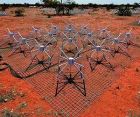
View Murchison Widefield Array's top competitors like ERAU Prescott Observatory, Pulsar Search Collaboratory, and Voyages.

Voyages.App is your ultimate travel companion, offering a diverse array of travel, trips, and expeditions. With a passion for exploration and adventure, our platform is designed to cater to all your travel needs. Discover exciting destinations, find the best travel deals, and embark on unforgettable journeys with us. Whether it's a dream vacation, a business trip, or a cultural escapade, voyages.app is here to make your travel experience seamless and extraordinary. Explore the world, create lasting memories, and let us be your guide to a world of limitless possibilities.
CA
Private
$8.1M Revenue
https://voyages.app
155 Employees

Did you know that the world's largest, fully steerable radio telescope, the Green Bank Telescope (GBT), is nearby in Green Bank, WV? Because of its sensitivity, this 100 meter dish is very important to the scientific community. In the last twelve years, 165 Terabytes of data have been collected by the GBT for the purpose of discovering new pulsars. The Pulsar Search Collaboratory (PSC) is a unique program which allows high school students to conduct authentic scientific research towards discovering new pulsars! Student PSC teams join an international community of scientists who analyze GBT data and conduct original research in pulsar astronomy. (Pulsars are rapidly spinning, highly magnetized neutron stars whose study has shaped the world's understanding of astrophysics!) The PSC is collaboration between the Green Bank Observatory (formerly the National Radio Astronomy Observatory) and West Virginia University's Center for Astrophysics that is funded by a National Science Foundation grant. Student teams analyze new sets of data collected by the GBT. This data has been set aside specifically for PSC student projects, so it has not even been viewed by scientists! Teens will learn how to identify previously unknown pulsars and how to recognize and classify changes in known pulsars. PSC Teams that make significant scientific discoveries may choose to publish academic papers on their findings. Former PSC students discovered new pulsars and became published authors, before even graduating from high school. PSC teams may be invited to an all-expenses-paid weekend Capstone seminar at WVU in May, where they can present their findings, interact with leading researchers, discuss their work with both scientists and other students, attend lectures, and learn to prepare a professional research poster. PSC members can also apply to attend a week-long extended summer research experience at the GBT. Students who commit to the project for two years can earn 3-6 college credit hours through their work.
Green Bank, West Virginia, US
Private
$5M Revenue
http://www.pulsarsearchcollaboratory.com
This resource is used for Space Physics students and the astronomy community in Prescott. Students use the observatory for collection and analysis of astronomical data for use in research projects for degree requirements. Faculty members also use the observatory for research and to provide outreach to the community through public viewings, open houses and other events in conjunction with local educators and astronomy enthusiasts. Space physicists and astronomers are making great strides in understanding the nature of the universe and everything in it. These scientists observe, record, interpret, and develop theories to explain celestial and physical phenomena. From the vastness of space to the infinitesimal scale of subatomic particles, they study the fundamental properties of the natural world to gain a better understanding of our universe. Students learn the physics of the solar-terrestrial and distant-space environments and how to study the magnetic and electric phenomena which occur in outer space, in the upper atmosphere of planets, and on the sun. The observatory provides ground-based radio and optical instruments to study these phenomena. The ERAU-Prescott Observatory operates as both a visual observatory and a radio science observatory. The visual observatory is equipped with a variety of telescopes designed foremost for students to conduct astronomical research projects. The observatory telescopes consist of a 16 Meade SX200 on a yoke mount, a 12 Meade on a German Equatorial Mount and an 11 Celestron EdgeHD on a portable mount. The 16 telescope is equipped with precision tracking suitable for exoplanet detection and is located in the main dome. The other two telescopes are set up for astrophotography and are located in the CDT building with a roll off roof. The radio observatory consists of several telescopes of a variety of designs covering VLF to SHF (20 KHz to 2 GHz). The principal research telescope is the DART (Distributed Array Radio Telescope ) telescope consisting of three 5-meter square ...
Prescott, Arizona, US
Private
http://erau-prescott-observatory.com


G2Crowd Trusted

300K+
Plugin Users
