


View MakerBay's top competitors like Adafruit Industries, Chandler Technology Inc, and FabLab ENIT.

Adafruit was founded in 2005 by MIT engineer, Limor "Ladyada" Fried. Her goal was to create the best place online for learning electronics and making the best designed products for makers of all ages and skill levels. In the last 15 years, Adafruit has grown to over 100+ employees. Adafruit has expanded offerings to include tools, equipment, and electronics that Limor personally selects, tests, and approves before going in to the Adafruit store. Adafruit is a 100% woman owned manufacturing company, a certified Minority and Woman-owned Business Enterprise (M/WBE), a certified Women’s Business Enterprise (WBE), and WOSB.
During the COVID-19 outbreak Adafruit Industries is operating as an essential service and manufacturing business: NYC – Executive Order 202.6 making PPE and medical device components. Adafruit was appointed to the Small Business Sector Advisory Council by the City of New York to help restart the NYC economy.
Post pandemic New York City launched a new Industrial Working Group which Adafruit is Co-Chairing, bringing together leaders from across the city’s industrial and manufacturing sectors with academics and policy experts to redefine the sectors’ needs and opportunities.
In 2024 Adafruit moved to Industry City! Brooklyn, New York! Industry City is a six-million-square-foot ecosystem in Brooklyn, NY - a bustling workplace for professionals across multiple disciplines including USA advanced electronics manufacturer Adafruit Industries! After hours and on weekends, Industry City becomes Brooklyn’s unofficial backyard, offering live music, festivals, dining, and tons of retail.
New York City, New York, US
Private
$28.4M Revenue
https://www.adafruit.com
77 Employees
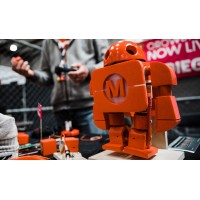
Part science fair, part county fair, and part something entirely new, Maker Faire is an all-ages gathering of tech enthusiasts, crafters, educators, tinkerers, hobbyists, engineers, science clubs, authors, artists, students, and commercial exhibitors. All of these “makers” come to Maker Faire to show what they have made and to share what they have learned.
The launch of Maker Faire in the Bay Area in 2006 demonstrated the popularity of making and interest among legions of aspiring makers to participate in hands-on activities and learn new skills at the event. 200,000 people annually attend the two flagship Maker Faires in the Bay Area and New York, with an average of 44% of attendees first timers at the Bay Area event, and 61% in New York. In 2017, over 190 independently-produced “Mini Maker Faires” plus over 30 larger-scale Featured Maker Faires will have taken place around the world, including Tokyo, Rome, Shenzhen, Taipei, Seoul, Paris, Berlin, Barcelona, Detroit, San Diego, Milwaukee, and Kansas City.
Maker Faire is primarily designed to be forward-looking, showcasing makers who are exploring new forms and new technologies. But it’s not just for the novel in technical fields; Maker Faire features innovation and experimentation across the spectrum of science, engineering, art, performance and craft.
Maker Faire is a gathering of fascinating, curious people who enjoy learning and who love sharing what they can do. It’s a venue for makers to show examples of their work and interact with others about it. Many makers say they have no other place to share what they do. DIY (Do-It-Yourself) is often invisible in our communities, taking place in shops, garages and on kitchen tables. It’s typically out of the spotlight of traditional art or science or craft events. Maker Faire makes visible these projects and ideas that we don’t encounter every day.
San Mateo, California, US
Private
$374.4M Revenue
http://makerfaire.com
32 Employees

Chandler Technology Inc is a company based out of 6735 Clearwater Ranch Rd, Wills Point, Texas, United States.
US
Private
http://www.techshop.ws/ts_chandler.html
2 Employees
Top MakerBay Employees

Related Companies
















G2Crowd Trusted

300K+
Plugin Users
