


View Make Westing's top competitors like Chandler Technology Inc, FabLab ENIT, and Maker Faire.

MakerBot offers a complete 3D printing education ecosystem, providing educators and students with the tools and resources they need to successfully 3D print in the classroom.
MakerBot's solutions go beyond a simple 3D printer, and provides a wide range of resources, including curriculum development, educator and student training programs, design thinking courses, 3D printing guides, 3D printing software, a community of educators, and more.
Brooklyn, New York, US
Private
$163.2M Revenue
https://www.makerbot.com/
89 Employees
Founded in 1996 in Durham, North Carolina, ShopBot Tools, Inc., designs, manufactures and distributes CNC (Computer Numerically Controlled) routers for milling, drilling, and cutting of wood, plastic, metals and other materials — powerfully, precisely, and affordably.
Now into our third decade of technology innovation, ShopBot’s digital fabrication tools are carving out the future of manufacturing, production, prototyping, grassroots “making,” and education. Today, over 10,000 ShopBots are at work in small shops and larger production facilities across the U.S. and around the world. They are used in a range of production operations: plastic trimming, aluminum drilling, signmaking, cabinetmaking, and all types of woodworking, as well as in the production of stealth fighters and manufacturing hi-tech housing.
Durham, North Carolina, US
Private
$7M Revenue
https://www.shopbottools.com
31 Employees
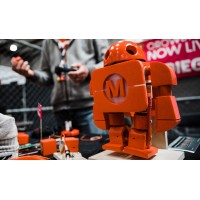
Part science fair, part county fair, and part something entirely new, Maker Faire is an all-ages gathering of tech enthusiasts, crafters, educators, tinkerers, hobbyists, engineers, science clubs, authors, artists, students, and commercial exhibitors. All of these “makers” come to Maker Faire to show what they have made and to share what they have learned.
The launch of Maker Faire in the Bay Area in 2006 demonstrated the popularity of making and interest among legions of aspiring makers to participate in hands-on activities and learn new skills at the event. 200,000 people annually attend the two flagship Maker Faires in the Bay Area and New York, with an average of 44% of attendees first timers at the Bay Area event, and 61% in New York. In 2017, over 190 independently-produced “Mini Maker Faires” plus over 30 larger-scale Featured Maker Faires will have taken place around the world, including Tokyo, Rome, Shenzhen, Taipei, Seoul, Paris, Berlin, Barcelona, Detroit, San Diego, Milwaukee, and Kansas City.
Maker Faire is primarily designed to be forward-looking, showcasing makers who are exploring new forms and new technologies. But it’s not just for the novel in technical fields; Maker Faire features innovation and experimentation across the spectrum of science, engineering, art, performance and craft.
Maker Faire is a gathering of fascinating, curious people who enjoy learning and who love sharing what they can do. It’s a venue for makers to show examples of their work and interact with others about it. Many makers say they have no other place to share what they do. DIY (Do-It-Yourself) is often invisible in our communities, taking place in shops, garages and on kitchen tables. It’s typically out of the spotlight of traditional art or science or craft events. Maker Faire makes visible these projects and ideas that we don’t encounter every day.
San Mateo, California, US
Private
$374.4M Revenue
http://makerfaire.com
31 Employees
Related Companies





G2Crowd Trusted

300K+
Plugin Users
