


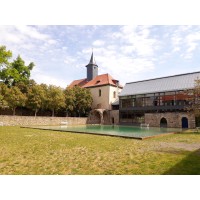
View Kloster Volkenroda's top competitors like Gemeinde Beuron, Kloster Banz, and Kloster Hegne.
900 years of Viticulture
The wine estate of the Eberbach Monastery, the latter of which was founded in 1136 by St. Bernhard of Clairvaux (Burgundy)
has, through its tireless pursuit of quality, made wine history. This centuries-old tradition has led the Eberbach Monastery to
become the largest German wine estate, a tradition carried on after the monastery's secularization in 1803 through the Dukes of
Nassau, then beginning in 1866 as Royal Domain by the state of Prussia and since 1945 by the Federal State of Hesse as
proprietor of the wine estate.
Since 1806 the estate has conducted its own auctions, and, as the leading German producer, was one of the founders a hundred
years ago of the „Verband Deutscher Prädikatsweingüter“ (Association of German Premium Wine Estates), then known as the
„Verband Deutscher Naturwein-Versteigerer“ (Association of Premium Wine Auctioneers). Already at that time the list of clients
of the estate read like an excerpt from the roll call of European nobility. Even Otto von Bismarck, the German chancellor, the
German Emperor and the Rothschild banking family appreciated the wines of the Eberbach Monastery.
The wine treasury of the monastery, which dates back as far as 1706, today still houses noble wines from that era, which
represent some of the most valuable in the world.
With the knowledge that the fundamentals of highest quality wines lie in the vineyard, the Cistercians, the Nassau dukes and
the Prussians acquired the best vineyards, thereby giving the estate command over unequaled holdings on the Hessische Bergstrasse
and in the Rheingau.
Wines of historical quality standards are produced in the three wine cellars in Bensheim, Assmannshausen and at the Steinberg
just outside the Eberbach Monastery.
Eltville, DE
Private
http://www.kloster-eberbach.de/wein/
38 Employees

Impressum: https://maria-laach.de/impressum
Unsere Geschichte reicht zurück bis in das Jahr 1093 a.D. Dieses Jahr gilt als das Gründungsjahr unserer altehrwürdigen Benediktinerabtei. Seitdem haben über die Jahrhunderte die Benediktinermönche, die hier lebten, mit ihrer Hände Arbeit, den Fortbestand des Klosters gesichert. Schon in der Regel des Heiligen Benedikt ist überliefert, dass Landwirtschaft betrieben und Handwerk ausgeübt werden soll. Denn Faulheit ist der Seele Feind. Beten und Arbeiten – Ora et labora.
Wir, die Mitarbeiter der Benediktinerabtei haben diese Aufgabe übernommen: Den Fortbestand der Benediktinerabtei von Maria Laach zu sichern. In vielen verschiedenen Betrieben mit den unterschiedlichsten Professionen sorgen bis zu 250 Mitarbeiter dafür, dass die verbliebenen Mönche bei Ihrer Gottessuche unterstützt und die über 900 Jahre alten Gebäude in Stand gehalten werden können.
DE
Private
https://maria-laach.de/impressum
8 Employees

Kloster Loccum is a music company based out of 2 Kloster, Rehburg-Loccum, Lower Saxony, Germany.
Rehburg-Loccum, DE
Private
$200K Revenue
http://www.kloster-loccum.de
4 Employees


G2Crowd Trusted

300K+
Plugin Users
