



View Capital Museum's top competitors like China National Silk Museum, Guangdong Museum, and Hunan Provincial Museum.
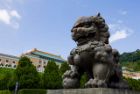
Founding of the National Palace Museum
The collection of cultural artifacts held by the National Palace Museum is composed of an enormous treasure trove of objects inherited from the previous Sung, Yüan, Ming and Ch'ing dynasties. When the Republic of China was first founded, these imperial treasures had remained within the Forbidden City with the last Ch'ing Emperor Pu Yi, but countless works of art were lost either because they were granted by Pu Yi as presents, because they were borrowed by his past noblemen, or because they were pledged to pawnbrokers or stolen.
In 1914 the Republic of China Government relocated the cultural artifacts preserved at the Rehe Imperial Summer Retreat and the Shenyang Former Palace to the outer court of the Forbidden City, and made them available for public viewing at an Exhibition Office of Ancient Artifacts. In 1924 Pu Yi moved out of the Forbidden City, and the Government formed a "Committee for the Disposition of Ch'ing Imperial Possessions" to reorganize the invaluable artifacts stored within the Palace. On October 10, 1925 on National Day, the National Palace Museum was officially inaugurated to preserve the imperial collections and palatial treasures from the various Chinese dynasties, so that all members of the public and future generations will henceforth be able to freely enter the Palace to admire this cultural inheritance of humankind.
During the first years of the National Palace Museum, a board of directors was set up as the decision-making and supervisory organ, which supervised over a subordinate board of executive directors, the two separate departments of Antiquities and Books, as well as the General Affairs Office. Over the years dramatic political changes ensued, and the National Palace Museum was in turn governed by the Maintenance Officer, Preservation Committee, Maintenance Committee and a Management Committee.
台北市, TW
Private
$68.4M Revenue
http://www.npm.gov.tw
122 Employees
Established in 1925, the Palace Museum is located in the imperial palace of the consecutive Ming (1368-1644) and Qing (1644-1911) dynasties. The magnificent architectural complex, also known as the Forbidden City, and the vast holdings of paintings, calligraphy, ceramics, and antiquities of the imperial collections make it one of the most prestigious museums in China and the world. In 1961, the State Council designated the former imperial residence as one of China's foremost-protected cultural heritage sites, and in 1987 it was listed as a UNESCO World Heritage site.
CN
Private
$14.7M Revenue
https://www.dpm.org.cn/Home.html
121 Employees
National Museum of China, Chinese (Pinyin) Zhongguo Guojia Bowuguan or (Wade-Giles romanization) Chung-kuo Kuo-chia Po-wu-kuan, museum in Beijing, located on the east side of Tiananmen Square. The museum was created in 2003 by the merger of the National Museum of Chinese History and the Museum of the Chinese Revolution. It is the largest museum in China and one of the largest museums in the world. The National Museum of Chinese History, the main exhibits of which covered the history of China from its earliest beginnings up until the Chinese Revolution of 1911–12, was established at the former Imperial College of the Ming and Qing dynasties in 1912 and later expanded to rooms above the south gate of the Forbidden City and associated spaces. It opened to the public in 1926 and was reorganized in 1997 based on the latest archaeological and historical findings and arranged in chronological order. The Museum of the Chinese Revolution, established in 1950, was dedicated to the history of China from about 1840 onward, particularly highlighting the history of the Chinese Communist Party. A new building to house the two museums was completed in 1959. After China won the bid to host the 2008 Olympic Games in Beijing, officials decided to combine the museums into a single entity and embarked on a massive renovation of the building. Construction began in 2007, and the museum reopened to the public in 2011, boasting some 2,153,000 square feet (200,000 square metres) of space—nearly three times its original size. The museum’s collection features more than one million objects, ranging from replicas of bones of Peking man to scientific instruments introduced to China by missionaries in the 18th and 19th centuries and many hundreds of decorative objects—such as bronzes, pottery, lacquerware, jade, and textiles—and documents, art, and artifacts ranging from the Paleolithic Period to the present.
CN
Private
http://en.chnmuseum.cn/
64 Employees
Related Companies





















G2Crowd Trusted

300K+
Plugin Users
